vendredi 23 juillet 2010

Lewd Frenchies


What a game that was last week! The Steelers won it 21 to 10 against the Seahawks. But do you remember the result of the 2004 edition of the Superbowl? Maybe, but what most people will remember about the game is… the Janet Jackson/Justin Timberlake wardrobe “malfunction”.

No need to show the picture for the umpteenth time. Everybody knows, as everybody knows the outcry it triggered all across America. A nipple! For 3 seconds on TV, with an audience totalling over a hundred million. In Europe, and in France for that matter, there was a general feeling of incredulity after the pictures were shown relentlessly, unpixelized for everyone to see. So, that’s what it was all about? Where’s the problem? Are Americans that frightened by the sight of a breast? French TV shows that all the time.

But maybe the French had some reason to smile at the seemingly puritan stand of Americans regarding nudity and the women’s body by and large. They’ve been there before… 

Museums all over the world are filled with paintings and sculptures of nudes. But there’s one in particular, probably only a French artist could have painted. His name is Gustave Courbet (1819-1877) and he is known as the master of the realist school. His most famous painting is “Bonjour Monsieur Courbet” (aka “the meeting”). But he also made one, called “L’Origine du Monde” (”the origin of the world”) that once belonged to the ambassador of the Ottoman Empire in Paris, and, among others, to the famous French psychoanalyst Jacques Lacan. When the latter died in 1981, his collection was donated to the Musée d’Orsay in Paris where this painting is now on unrestricted display and accessible to all visitors. 

That explains why the French were a bit amused by the tremor that jostled America at the sight of a nipple on TV when they are presented as masterpieces in museums…

So could this outstanding painting by Courbet travel to America and be exposed at the Art Institute of Chicago Museum or in the Austin Museum of Art? 

And do you think this sort of thing contributes to the reputation of the French regarding all things related to sex?

jeudi 22 juillet 2010

Anti-Americanism and the innocent Frenchies


One of the trickiest impediments for mutual comprehension when having a discussion with many Americans is the notion of anti-Americanism. Save for the former USSR where it wasn’t about being anti-Russian but anti-Communist, America is the only country in the world to which the infamous “anti” prefix can be associated. Hmmmm… There must be some misunderstanding here…

This is where the “anti” prefix is misleading. It basically means “against” and one must concede that when taken at face value by Americans, it invariably seems to be an attack directed to the very heart of their identity and their being, with a goal that seems to be no other that the negation of said identity, “anti” being then an implicit synonym for nothingness.

Where other countries accept criticism as a run of the mill occurrence between foreign nations, peoples or different cultures, the slightest critic of America can very easily be misunderstood because it touches a raw nerve and is assimilated to a global and total rejection. A denial of love, so to speak.

Maybe is it the misfortune of America to be a late comer on the world stage, where all civilisations have centuries, sometimes millenniums of history and arts behind them. All countries in the world have long ago shown their mettles and know that the meaning of life is morality, in the sense of “Being” (l’être) as opposed to “Having” (l’avoir). Therefore, America’s history seems to be a continuous overreaction that translates into a permanent endeavour to surpass the rest of the world in terms of might, be it economically or militarily. But this is all about “Having.” And yet, a need subsists: That of being recognized at par with the others in the realm of “Being“. 

Hence, from 2003 to, say, 2007, a virtually unique chord has been harped by the American media to “explain” the French opposition to the war in Iraq, that of anti-Americanism (notwithstanding the loads of garbage). To a majority of Americans, if there’s a country that can be labelled anti-American, it’s France, no doubt about it. The more the French insist they’re not, the more Americans decry them as sheer hypocrites.

So when the Bush administration made the American people believe their security was at stake because of Iraq’s purported WMD and the French, seemingly, not only refused to come to their help but even tried to prevent their right to defend themselves, that was absolute and definitive evidence that the French were anti-American, in the sense that they opposed the very existence of America. Weren’t the French denounced as the closest friends of Saddam whose supposed goal, precisely, was to attack and destroy America?

During his interview with Christiane Amanpour on CNN to expose to the American people the position of France regarding the refusal of Paris to back America in its drive to wage war to Iraq, former President Chirac felt compelled to assert he wasn’t acting out of anti-Americanism… Talk about being ridiculous! How could that even be?

For historical as well as cultural reasons, France occupies a specific place in the psyche of America, its “bad conscience” used to say Susan Sontag. Therefore, when the French criticize America, the country which probably is the closest to their heart, most Americans receive that critic not as such but as an ongoing evidence of the malevolence of the French toward them. Not for what they, Americans, do but for what they are. All attempts of the French in order to convince their American friends that this is not the case fall on deaf ears. From the superiority complex they certainly suffer from, the French can only despise and have contempt for Americans that they consider under-educated, uncouth and historically as well as artistically “inferior”. And yet, is there another country where artists are as well received and celebrated than Americans in France? 

Isn’t that what love stories are made of : misunderstanding? The miss often complaining of the lack of real love from her partner while said partner keeps on insisting he’s innocent and loves her more than anything else.


Note: The picture is “Lovesong” by Georgio de Chirico, Museum of Modern Art, New York

mercredi 21 juillet 2010

An American promenade in Paris


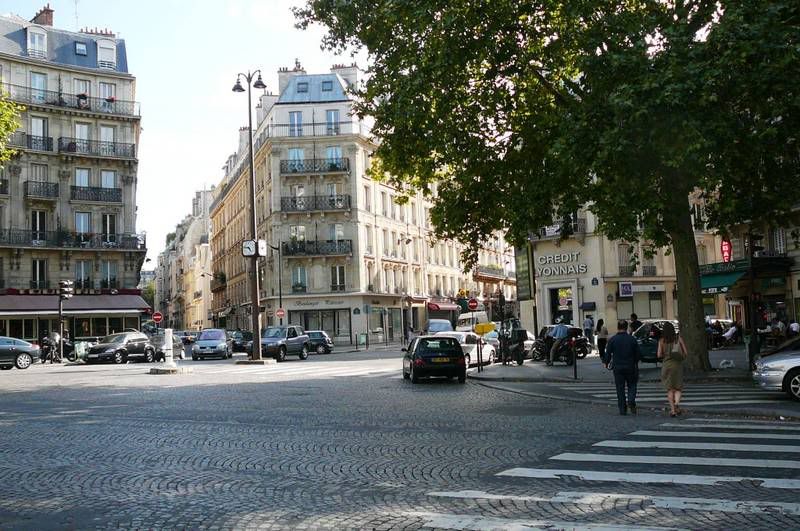
In the wake of the anti-French campaign launched by the American media in the last three years, four true American patriots were in Paris last July, wanting to check by themselves how deeply anti-American the French really are. As they leave their hotel on the Place des Etats-Unis (16th District), not far away from the Avenue de New-York*, let’s go along with them on a little stroll throughout the City of Lights. 

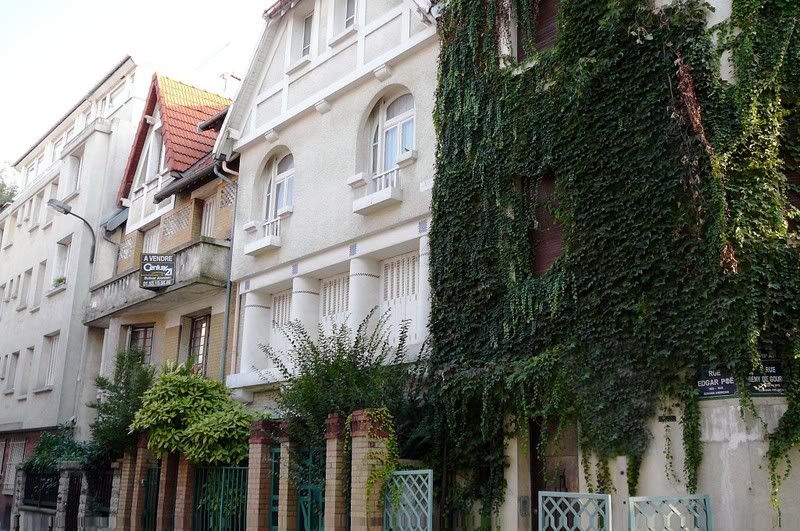
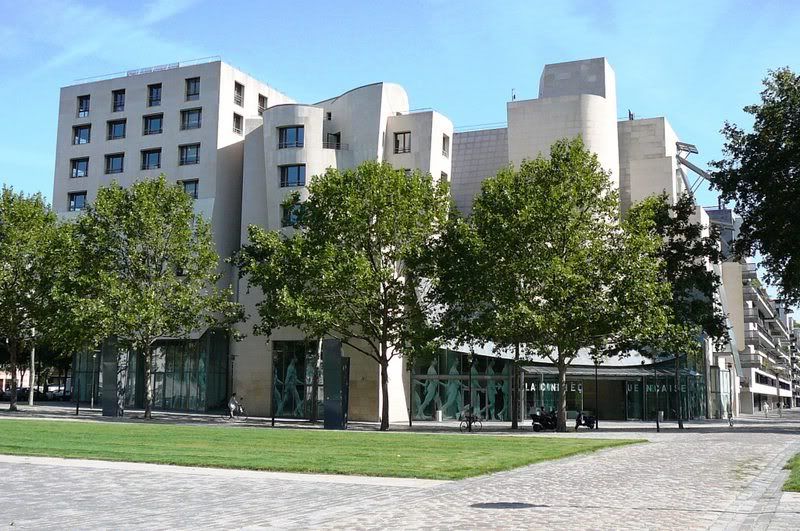
The first one, an artist, first went through the Rue Edgar Poe (19th), the Rue Edgar Varese (19th), then headed south to the Rue George Gershwin (12th), the Place Louis Armstrong (13th), the Place Léonard Bernstein in front of the French Cinémathèque built by architect R.F. Gehry (12th) and ended up Rue Ernest Hemingway (15th) not far from the Place Joséphine Baker (14th). Tired after such a long stroll, he sat down at a café, where he ordered a drink with plenty of ice but ended up with 2 minuscule ice cubes at the bottom of his glass. ”Probably because I’m American,” he thought! 

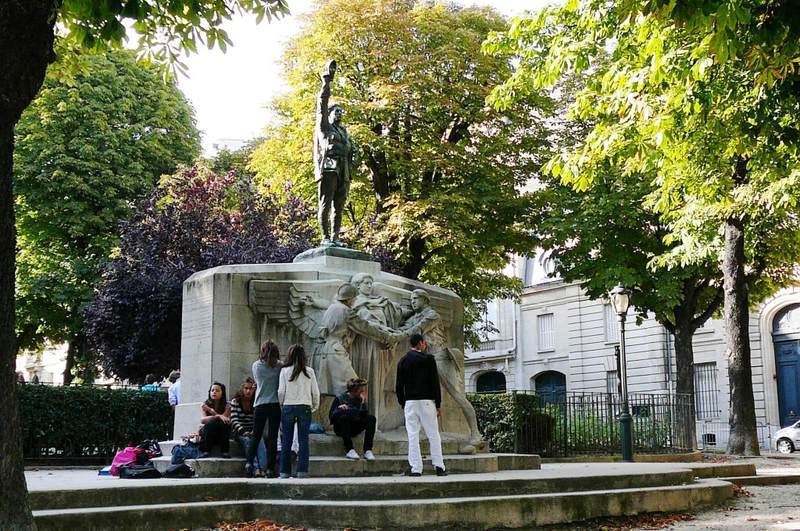
The second, a war veteran and native of Austin, Texas, had heard that the embassy of the Independent Republic of Texas once had its own place in Paris. So he asked passer-bys if they knew where the embassy had been. To no avail, as none of them even made any effort to understand English. He eventually spotted a tiny plaque carved in the wall but couldn’t decipher it since it was written in French. Couldn’t they have made the effort to write in English? He thought, I mean that was our embassy! So after he left the Square Yorktown (16th), he went Place du Général Patton (16th), and continued on Avenue du Général Eisenhower (8th) and eventually ended up Boulevard Pershing (17th).

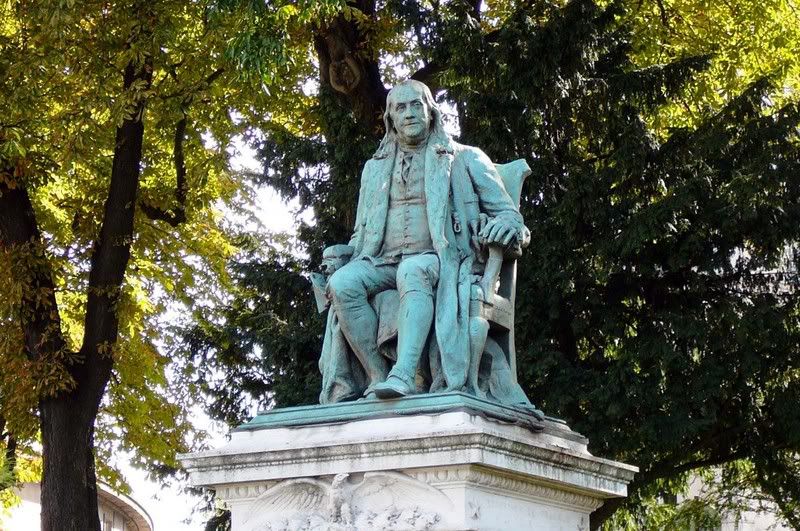
The third one, a science student, after attending mass at the American Cathedral in Paris (8th), went straight to the Rue Benjamin Franklin (16th) and from there to the Rue Fulton, the Rue G. Eastman and the Avenue Edison (all three in the 13th). There, he decided to take the Metro back to his hotel. Until he found out that the station manager simply refused to accept his dollars or even his American Express card. A sight caught his attention as the metro was passing over the Seine. It is fair to say there was a moment when he thought the French weren’t that bad if they so much admire the Lady Liberty statue that they copied it. But, why is theirs so ridiculously small?

The fourth one, a Baton Rouge, Louisiana, native wanted to see the Rue named after his home state, Rue de la Louisiane (18th). After crossing the Rue Lincoln (8th), the Rue Washington (8th), the Avenue du Président Wilson (16th), the Avenue du Président Kennedy (16th) and the Avenue F.D. Roosevelt (8th) nearby the metro station named after the 32nd American president, he felt sourly disappointed that only six American presidents had been honored by the ungrateful French. Too bad this Parisian visit took place the last week of July; he didn’t know that on the 4th of this very month a statue of Jefferson had been inaugurated on the bank of the river Seine in front of the Musée d’Orsay. That would have made seven…

This is when he picked up a newspaper and found out that the Tour de France had just disqualified its American winner Floyd Landis, under the pretext that he had tested positive for doping.

Our four red-blooded Americans then had enough evidence to be definitely convinced of the ingratitude of these people toward the generous country who gave France so many opportunities to honour Paris with American names. 

The French! So anti-American!

* Situated along the Seine, facing the Eiffel tower. Talk of a location! 

Note 1: Needless to say, this American stroll is to take cum grano salis…

Note 2: The picture is “The Boating Party” by Mary Cassatt (1893-94; Oil on canvas, National Gallery of Art, Washington). Mary Cassatt, a prominent American painter, spent most of her life in Paris.


mardi 20 juillet 2010

Madame, your obedient servant am I


In America, the French are often mocked for being old-fashioned, ensconced in useless formalities and lacking that warmth which makes Americans so straightforward in their personal relationships. Every American tourist guide that I happen to look at never misses to insist on the importance of being polite and respectful of a certain set of social rules when addressing the French.

One of the French’s strange habits is hand-kissing. Not that it is practiced on a daily level by every Frenchman to every woman he meets but yet, as a regular offender myself, I can attest it is always welcomed with a certain shy delight by ladies, particularly the ones from over the pond…

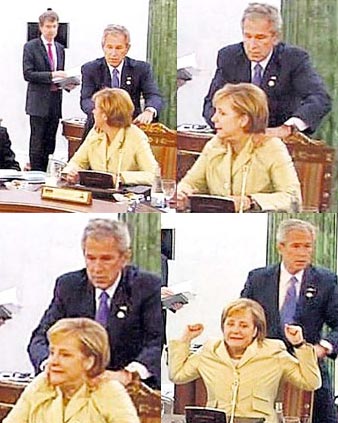
Now, here’s another Frenchman who often indulges in hand-kissing. Yes, Jacques Chirac, the former French President, was an enthusiastic adept of hand-kissing and everyone concedes he was a master at it. Whether with Laura Bush or Angela Merkel, the man knew how to behave. Speaking of Angela Merkel, the lady has had another opportunity to be greeted in a more modern version by another head of State…

One must concede Americans are right, the French often are too formal and waste too much time in meaningless niceties but then again, doesn’t it have a charm of its own?


Note 1: It goes without saying that this post doesn’t address all Americans but rather one in particular…

Note 2: The picture is the Arnolfini portrait by Jan van Eyck (1434), in London, National Gallery.

lundi 19 juillet 2010

The sexuality of lobsters


“As I was surfing through night TV channels on the cable, I eventually stumbled upon one where some people were having an apparently entertaining discussion and seemingly having a good time at it. With my broken French, I could understand they were talking about the sexuality of lobsters. And then, after a while, they changed the topic and started a vehement debate about the letters of Gustave Flaubert. I was totally mesmerized. And I realized a vivacious man was the moderator and he seemed so impassionate and at ease with every subject that could possibly be addressed. "Oh so French did I then say to myself!”

dimanche 18 juillet 2010

America haters


Between 2003 and 2007 there was anything genuinely positive about France or the French in most of the American medias. From outright detestation to plain scorn, tease and racist “jokes", we had our fill of hatred and vilification. And I’m just thinking of the mainstream media, be it TV, radio and newspapers where clichés and disinformation abound. 

The way France and the French were spoken of in some quarters often made me think of Radio Berlin speaking of the Jews in 1943. But thas was just the visible part of the French-bashing iceberg in the US. 

samedi 17 juillet 2010

French animals


Let us have another look at the “French = surrender” theme, which has become obsessional in today’s America.

I had written before that there was a moral dimension in the association of French = surrender = coward = inferior = despicable.

We must push forward this succession of analogies:

vendredi 16 juillet 2010

Faux amis


I never had before the opportunity to watch a computer-animated movie. So, when Ratatouille, the new Disney movie went on French screens I thought it was high time to make up for lost time. Isn’t the action supposed to take place in Paris? And isn’t it about French “Grande Cuisine”? How will our American friends from Pixar manage to mix these ingredients into a family-oriented entertainment?

jeudi 15 juillet 2010

Malcontent Frenchies


One of the many clichés that our American friends can find in most of their media or tourist guides is that the French are a Latin people; hence the differences and difficulties to accept or even understand the way things are done in France.

Excuse me, the French, a Latin people? The people living in France whose name comes from the Franks? Granted, the Romans invaded and colonized ancient Gaul but that was after the place had been occupied by the Celts for centuries, and well before being invaded again by the Huns, the Vandals, and the Normans. There is nothing Latin about the people living in Brittany for example, or those living on the eastern border with Switzerland or Germany. Or those located above the Loire valley for that matter.

mercredi 14 juillet 2010

So wrong


It took me much time to realize but eventually I’ve got to admit it: I had it wrong all the way! Since I’ve been meeting and exchanging with Americans, I’ve tried relentlessly to convince many of them that the French weren’t particularly “anti-American”. And yet, in the eyes of most Americans, if there’s one country they will think of as the perfect embodiment of anti-Americanism, it is France.

mardi 13 juillet 2010

Yes, we're American


When we think of America we think big in the first place. Americans themselves often insist on how large their country is geographically speaking, as well as how powerful it is. Overdoing things seemingly looks like a defining trait of all things American (no negative understanding attached to the word).

How many times have I read signs related to anything in America boasting to be the greatest on earth (show, building, airplane, theatre, stadium, whatever) with the “only in America” sign?

lundi 12 juillet 2010

Sitting on a fence


Every year, millions of Americans come to visit Europe. And the name “Europe” is first of all associated with culture. In France only, about one hundred cathedrals dating back to the Middle Ages, thousands of churches that were built in the XIIIth, XIVth centuries and on. Add to this the thousands of châteaux and even more museums. And if we dig deeper in the past, there are also the prehistoric period with the many caves adorned with the carvings made by the first “Europeans” 15 to 20.000 years ago.

dimanche 11 juillet 2010

An American education


Any true French-bashing American patriot will assure you: the French are anti-American. The sky is blue, the rain is made of water and the French are anti-American. 

When asked why, the explanation probably will have something to do with French education, myths, and a systematic bias in the representation of America and Americans. The French are simply assumed to put some negative spin in just about everything related to America.

samedi 10 juillet 2010

Will you please mind your own business?


Three years ago, the presidential elections in France have been a renewed opportunity for most of the American MSM to display a permanent feature that is to be found in many articles reporting on our country: an obsession which translates into an incessant set of criticisms about how France is run, particularly its economy. Above all, the 35-hour workweek, the 5-week paid vacation and the free and high-quality healthcare and educational systems seem to be particularly unbearable to those many journalists, columnists and reporters who also seem to have trouble understanding why the labor market is regulated, why workers are entitled to social rights and protections, and even sometimes are allowed to go on strike.

After having been fed so much bias and disinformation, so many clichés and stereotypes for years, it’s no wonder that a great number of Americans may sincerely believe that France is a socialist (communist?) country on the verge of collapse, nearing bankruptcy with next to no hope of ever being salvaged. Unless… unless it adopts the American way. It doesn’t matter that similar social structures can be found in Germany, Italy or Spain and for that matter across most of Europe, save for Great Britain. For some reason, France is their bête noire…

After having diagnosed the ills, here comes the medicine: liberalism, globalization, free markets, more competition, less government intervention, no paralyzing trade unions, fewer taxes, more flexibility, etc… As if the French had never heard of those things…

Now, the point of this post isn’t to discuss the pros and cons of their “analysis,” but to try to understand what the process at work here is. 

Does anyone really think their first and foremost concern is the well-being of the French? Does anyone really believe they care and even wish for France to be a major actor on the world scene? Particularly in economic term, when the same people are all too ready to criticize and mock France for her pretension on the diplomatic stage? Or rather, isn’t this a pretty good illustration of a mindset posing as a universal standard-bearer as well as an indisputable benchmark that is beyond any questioning? Wouldn’t the world just be better if it were organized along the tenets of the American structures?

May I suggest that what we’re witnessing here is a perfect demonstration of the basic nature of imperialism: the refusal to accept the otherness of the one you want to subjugate, the impossibility of accepting the differences, the wish to have the other conform to one’s own model as well as the continual refusal of the other’s identity and integrity? Imperialism is also the belief that one is invested the responsibility - the duty, even - to teach the world how it should behave and the unassailable right to project and impose one’s own criteria upon everybody else. Isn’t it a commandment of God to lead the unfortunate to the right path and away from evil and make them to my own image while erasing any and all significant differences in the end?

The funny part is that when the French dare object to their well-meant counsellors, said counsellors can read no other “explanation” but sheer anti-Americanism. These people portray themselves as peaceful and benevolent missionaries who eventually fall victims of the violence and ungratefulness of the people they want to help. Ain’t life unkind? What they fail to understand is that the intolerance they claim the French to possess is none other than their own intolerance regarding the way other peoples want to live their lives. When they receive the reaction of those they want to oppress as an echo of their own meddling in others’ business, they regard it as incomprehensible aggression without apparently having the slightest idea that their numerous bits of advice are evidence of their massive intrusion into the vital space of the other, their denial of its specificity and their disrespect and blindness to other forms of social lives.

One English author had perfectly summed it up more than 250 years ago:
“Now, brother, to prescribe rules of happiness to others hath always appeared to me very absurd, and to insist on doing this, very tyrannical.”

- Henry Fielding - “History of Tom Jones, a Foundling” (Book XIV, chap. 8.)

On the other hand, is it so far-fetched to imagine that these same American reporters would be very pleased to benefit from these very rights the French have acquired and which eventually characterize the difference which makes life in France so attractive to many visitors from across the pond? What better way to keep the forbidden fruit at bay than to profess complete disdain for it?

 Talk about ambivalence!


Note: The illustration is "Allées et venues" by Jean Dubuffet.

vendredi 9 juillet 2010

Monolingual Yankees


Americans, the world over, have a reputation for being notoriously bad at speaking foreign languages. And indeed, except for a tiny minority, they are.

But you got to admit they have some excuses… Why should they learn a foreign language when they know they will never have any use of it? I mean, learning a foreign language is no cake walk. When you consider the amount of time, energy and personal implication that learning another language requires, it would appear quite logical to consider it a complete waste of time to spend hundreds of hours just trying to acquire the basics of a tool you perfectly know you will never have any opportunity to use. 

jeudi 8 juillet 2010

American warmongers


One of the recurrent themes of French-bashers in the years following the invasion of Iraq is the near obsessional hammering of the feats of the American army which supposedly came twice in the last century to save the butt of the French. Typically the sort of bragging the bullies in the schoolyards are fond to resort to, in the absence of intellectual achievements they could boast of… For one, isn’t there any other reason for a country to be proud of than its ability to sow death and destruction? But let’s take them at face value. Which are the wars the USA waged and how did it fare?

mercredi 7 juillet 2010

On reality and its representation


She wakes up, she makes up, she takes her time and doesn’t feel she has to hurry…

On the evening of Sunday the first of July 2007 she went to bed as usual. That was the last time. In the morning, she reluctantly left the cosy warmth of her sheets, she took a shower and she left home after she’d kissed her cat and her mother wished her a nice day. This Monday morning she had less than 10 hours left to live. At midday she had lunch with a friend of hers and was on her way to the metro station. 

mardi 6 juillet 2010

Nuances and subtleties


Even after they’ve spent many years in France, there’s a specific situation where American expats often are taken aback: no matter how well they speak the language, when it comes to writing letters there’s a very awkward moment: What is the right formula to conclude a letter?

lundi 5 juillet 2010

Return to sender


We all know this crock of shit about Americans having no culture, don’t we? For sure that is the most offending prejudice for our American friends to be constantly reminded of, when they know it really doesn’t hold water. Now, where does that prejudice come from, may we ask? It already has been discussed time and again but it may be worth another approach.

dimanche 4 juillet 2010

I need you ('cos it makes me feel better)


By and large we know how Americans don’t really care about the French and yet, how many clichés and prejudice commonly shared among a good number of them! And not exactly flattering in general…

The funny thing is to try to understand why the French are so specifically targeted. What have they done to Americans? One could expect the Germans not to be their favorite friends. Weren’t both twice at war within 25 years? And not precisely skirmishes. But no, nothing against the Germans. Or the Japanese (Pearl Harbour anyone?). What about the Vietnamese? Or the Russians after 40 years of cold war? Nichts, nada, zil, zero, rien. Well, I thought the Iranians were now America’s bêtes noires. But nothing against the people of Iran, just the leaders of the regime. And what about the English? Didn’t they burn down the White House in 1812? And they weren’t exactly helpful in Vietnam, were they?